Third-Party Risk Is Your Risk: A Vendor Cybersecurity Playbook for 2027

Nadia Patel
October 16, 2026 · 6 min read
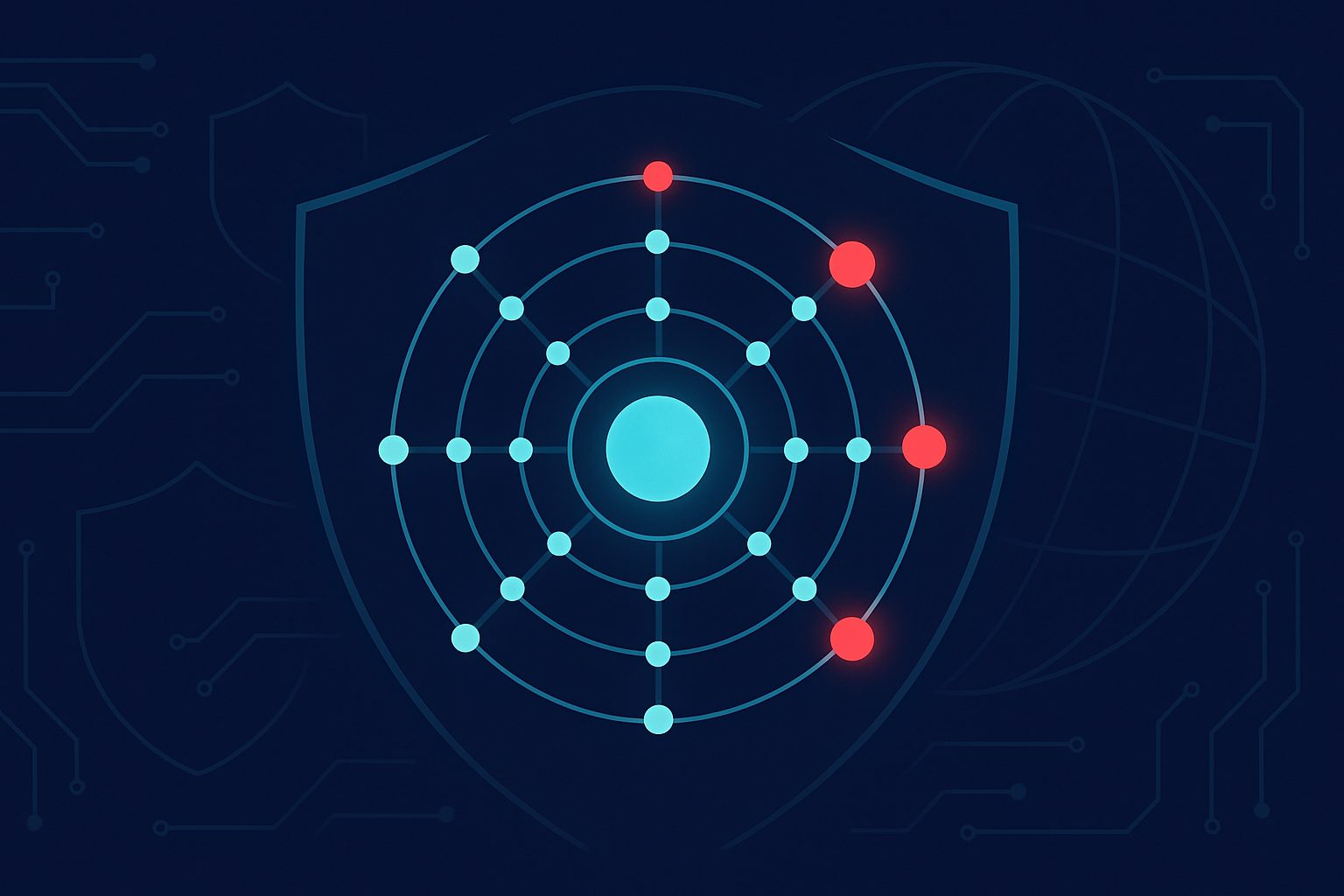
The uncomfortable truth of modern SMB security is that most of the serious incidents don’t start inside the business. They start inside a vendor. A compromised accounting platform. A breached managed-print provider. A payroll vendor whose IDP got phished. In 2027, your vendors are an inseparable extension of your attack surface — and your regulators, insurers, and clients already know it.
Why Vendor Risk Exploded
Three forces have converged over the last 24 months to put vendor risk at the top of the SMB security agenda:
Attackers followed the supply chain. Compromising a single SaaS vendor can give an attacker footholds in thousands of downstream customers simultaneously. For a mid-market attacker, that math is irresistible, and the result has been a steady drumbeat of supply-chain and shared-responsibility incidents: identity providers, remote-monitoring platforms, file-transfer tools, backup vendors, and MSPs themselves have all appeared on the receiving end.
Regulators and insurers followed the attackers. Vendor risk management requirements that used to live only in HIPAA, PCI, and defense-sector frameworks have spread. NY DFS Part 500, the SEC cyber disclosure rules, CMMC 2.0, state privacy laws, and the standard questionnaires every cyber insurer now sends all include substantial vendor-risk sections.
Clients followed the regulators. If you sell to any business of meaningful size, you have almost certainly been asked to complete a vendor security questionnaire in the last twelve months. The expectations are flowing in both directions.
An SMB that cannot credibly answer “how do you manage vendor risk?” is now at a measurable disadvantage — in audits, in insurance renewals, and in competitive sales processes.
What a Real Vendor Risk Program Includes
At the SMB scale, a defensible vendor risk program has five parts. Not twenty. Five.
- An inventory. A single, current list of every vendor that has access to your data, systems, or facilities.
- A tiering model. A simple classification — critical / standard / light — that determines how much scrutiny each vendor gets.
- An assessment process. A proportional review at onboarding and at a defined cadence thereafter.
- Contract language. Standard terms that your vendors agree to on their worst day as well as their best.
- Ongoing monitoring. A way to notice when something changes, between assessments.
Any one of those pieces on its own is weak. Together, they constitute a program a regulator, an insurer, or an acquirer will recognize.
Tiering: The Decision That Makes the Program Operable
The reason most SMB vendor risk programs collapse is that they try to treat every vendor equally. There are too many vendors, and nowhere near enough time. Tiering is how you make the problem tractable.
Critical Vendors
Vendors whose compromise would cause a material business, financial, or regulatory impact. Typical examples: your identity provider, your line-of-business application, your payroll vendor, your managed security provider, your backup and disaster-recovery vendor.
- Full security questionnaire at onboarding.
- Review of SOC 2 Type II report or equivalent.
- Documented contract clauses (see below) — non-negotiable.
- Annual re-assessment.
- Monitored for breach announcements and security news.
Standard Vendors
Vendors with meaningful but not business-critical access — a marketing automation platform, a project management tool, a specialized SaaS used by one department.
- Short-form questionnaire at onboarding.
- Confirmation of key controls (MFA, encryption, SOC 2 posture).
- Standard contract clauses.
- Biennial re-assessment.
Light Vendors
Vendors with no sensitive-data access — the office coffee service, a one-off consulting engagement, a utility billing provider.
- Basic onboarding checklist.
- Standard T&Cs.
- Re-assessed only on scope change.
The right tiering model should make the vast majority of your vendors “light” or “standard” — so the critical-vendor work actually gets the attention it needs.
Questions That Actually Matter
SMB vendor questionnaires are notorious for being either too long to complete or too shallow to inform anything. The following ten questions, answered honestly, surface the vast majority of real risk:
- Do you have a current SOC 2 Type II (or equivalent independent attestation), and will you share it under NDA?
- Where is our data stored and processed, and is it segregated from other customers’ data?
- Is MFA required for all employees with access to customer data or production systems?
- How do you detect and respond to security incidents, and what’s the notification timeline to us?
- How do you vet, monitor, and offboard your own subprocessors?
- Are backups of our data encrypted, tested, and retained for how long?
- Have you had a material security incident in the past 24 months, and what changed as a result?
- What is your business continuity and disaster recovery posture, including RTO/RPO commitments?
- How do you handle data return and destruction at the end of our relationship?
- Do you carry cyber liability insurance, and at what limits?
A vendor that answers those crisply, with evidence, is usually a safe partner. A vendor that evades them, or whose answers don’t match their written policies, is a signal worth taking seriously.
Contract Clauses That Actually Matter
A vendor security program with no contractual teeth is a wish list. The following clauses are the ones most frequently invoked when things go wrong:
- Breach notification. A defined notification window (typically 48 to 72 hours) and a defined content standard.
- Right to audit. At minimum, the right to receive the SOC 2 and penetration-test summaries on request; ideally, a reserved right to request additional evidence.
- Data return and destruction. A defined process for returning or destroying your data at termination, with written certification.
- Subprocessor transparency. A current list of subprocessors and notification of material changes.
- Insurance minimums. Cyber liability coverage at agreed limits with you listed as additional insured where appropriate.
- Indemnification for data incidents. Appropriate to the scale of the engagement and the sensitivity of the data.
Ongoing Monitoring — Not One-and-Done
Vendor risk doesn’t sit still between annual reviews. A few lightweight monitoring practices make a disproportionate difference:
- Subscribe to breach-notification feeds and news alerts for your critical vendors.
- Watch for sudden changes in vendor leadership, ownership, or security program (acquisitions and CISO departures often precede issues).
- Watch your own logs for unexpected changes in vendor access patterns.
- Reconfirm MFA, SSO, and privileged access periodically — configurations drift.
- Track vendor SLA performance; sustained performance degradation often indicates underlying operational distress.
Bottom Line
Vendor risk is not an exotic compliance exercise anymore — it is a core part of SMB security hygiene, and it is being asked about by every serious counterparty. A tiered, proportional program with a current inventory, a few sharp questions, defensible contract language, and basic ongoing monitoring is well within reach for a business of nearly any size, and it pays for itself the first time a vendor incident lands and you’re able to answer it from a position of preparation rather than surprise.
Brightworks IT helps clients stand up and operate right-sized vendor risk programs — including the questionnaires, contract language, and ongoing monitoring. Get in touch for a short review of where your current vendor posture is strongest and weakest.
How BrightWorks IT can help
Local IT support from our offices in Richmond, VA, Vernon & Hartford, CT, Hudson Valley, NY, Oneonta, NY, Southeast Michigan, Southern California.
Need Help With Your IT?
Schedule a free, no-obligation IT assessment with our team. We'll show you exactly where your technology stands.
Written by
Nadia Patel
Nadia covers cybersecurity, cloud infrastructure, and IT strategy for growing businesses. With a background in enterprise technology and a passion for clear communication, she helps business leaders understand the technology decisions that matter most.