MSP vs In-House IT: How Modern Businesses Decide — And When to Rethink the Model

Nadia Patel
September 2, 2026 · 6 min read
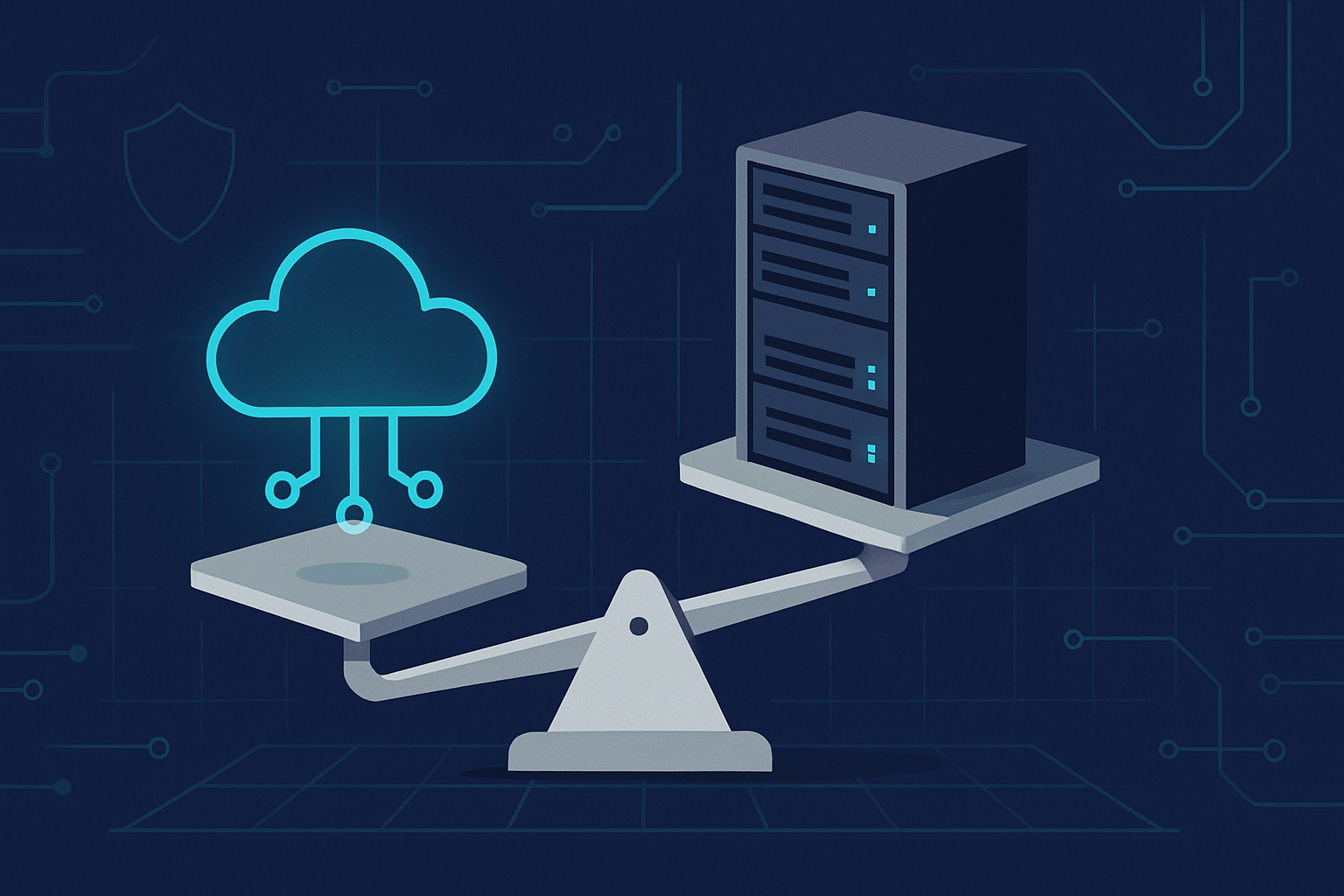
Some businesses run IT beautifully in-house. Some outsource it entirely and never look back. Most fall somewhere in the middle — and the “right” answer for any given business changes as the business itself changes.
The Question Behind the Question
Business owners don’t really ask “MSP or in-house?” They ask some version of:
- Are we getting enough for what we spend on IT?
- Is our current setup keeping up with the business?
- What happens if the person who understands everything leaves?
- Are we safe? And can anyone prove it?
The MSP-vs-in-house decision is a lever on those questions — but only one lever among several. The frame that produces better decisions is not “which model,” but “which capabilities do we need, and how do we source each one at the right level of quality and cost?”
The Six Capabilities Every Business Needs
Every functioning IT operation, regardless of size, delivers roughly the same six capability sets:
- End-user support — the help desk, laptop deployments, password resets, application access.
- Infrastructure operations — servers, network, cloud, backups, monitoring.
- Cybersecurity — detection, response, hardening, awareness, incident readiness.
- Applications and identity — Microsoft 365, business systems, single sign-on, access management.
- Projects and change — migrations, deployments, refreshes, integrations.
- Strategy and governance — budget, roadmap, compliance, risk, vendor management.
The mistake is assuming these capabilities all belong in the same box. In reality, the strongest IT organizations we see mix and match — strong internal support paired with an outside SOC, an internal CIO paired with a fractional infrastructure team, an MSP for the whole stack with a business-side product owner who represents users.
When In-House IT Is the Right Answer
Building and running in-house IT tends to be the right answer when several conditions apply at once:
- Technology is core to the product, not just supporting the business. A software company, a data-driven services firm, a manufacturer with highly customized OT.
- The organization is large enough to sustain multiple qualified operators in each capability set — not just one heroic generalist.
- The regulatory or contractual environment requires deep internal control over specific systems or data.
- Leadership is prepared to fund the ongoing training, tooling, redundancy, and management overhead that a professional IT organization actually costs.
In-house IT done well is expensive, high-value, and durable. In-house IT done under-resourced looks fine until the day it doesn’t.
When Managed Services Is the Right Answer
The MSP model is usually the right answer when:
- Technology is important to the business, but not what the business sells.
- The organization is not large enough to sustain full redundancy in every IT capability without over-spending.
- The business benefits from the “seen-it-before” effect — an MSP working across dozens of similar clients solves similar problems every week.
- Predictable, contractually-defined service levels matter more than hands-on customization.
- Cybersecurity and compliance obligations exceed what a small internal team can realistically maintain.
A well-run MSP is not simply cheaper IT — it is professionalized IT delivered as a subscription. The value shows up in the depth of the bench, the maturity of the tooling, and the coverage that a small internal team can’t provide alone.
The Hybrid Model — Where Most Successful Mid-Market Businesses Live
The purest “all in-house” and “all outsourced” postures are rarer than you’d think at the mid-market. Common hybrid patterns:
- Internal IT manager or director + MSP for delivery. The business retains a single accountable technology leader who represents the business, holds the MSP accountable, and owns the internal side. The MSP delivers most of the operational work.
- Internal help desk + external infrastructure and security. The business keeps user-facing support close (culture, response, physical presence) and outsources the deeper technical layers.
- Full internal IT + external MDR/SOC. The business runs its own IT operation but recognizes that 24×7 security monitoring is a specialty that requires scale.
- Internal IT + fractional CIO. The business has execution capability but lacks executive-level strategy; a vCIO fills that specific gap.
These models exist because they work. The organizations that resist them — insisting on either total in-house control or total outsourcing — tend to overspend or under-deliver.
Signals It’s Time to Rethink Your Current Model
The right answer changes as the business changes. Common signals that your current sourcing model has drifted:
- Key-person risk. One person understands the environment, and their absence would be catastrophic.
- Growing security or compliance gaps. Requirements you didn’t have three years ago are now unmet.
- Persistent unmet backlog. Projects that should have been done last year keep slipping because there’s no capacity for change — only firefighting.
- Slipping response times. Users are waiting hours or days for things that used to take minutes.
- Rising costs with unclear return. IT spend is trending up, but leadership can’t articulate what it’s buying.
- Aging tooling. RMM, backup, endpoint, and identity platforms that haven’t been refreshed in years and now underperform the current class.
- M&A pressure. A pending or recent acquisition changes the shape of the IT problem overnight.
How to Run a Serious Evaluation
If you suspect it’s time to change model — or to validate that the current model still fits — the evaluation is worth doing carefully:
- Start with the capabilities. List the six capabilities above. Score current coverage honestly — not on a good day, but on a typical day.
- Cost each capability at fully-loaded rates. Include salaries, benefits, tools, training, management overhead, and downtime cost.
- Solicit real MSP proposals against a defined scope. Vague RFPs produce vague responses. Well-scoped ones expose real cost and real capability differences.
- Talk with reference clients of similar size and industry. Not the ones the MSP hand-picks — the ones you find via industry connections.
- Model transition cost and time. Whichever direction you go, the change itself has cost and risk. Real evaluations include the switch, not just the steady state.
Bottom Line
MSP vs in-house is a false binary. The real question is which combination of capabilities, sourced from where, at what price, gives your business the right coverage, the right resilience, and the right strategic bench for the next three years. That answer changes as the business changes, and revisiting it every two or three years is a discipline, not an admission of failure.
Brightworks IT works with businesses in both directions — standing up managed services where in-house has outgrown its capacity, and complementing internal teams where the right shape is hybrid. Get in touch for a candid conversation about which model fits where you’re headed.
How BrightWorks IT can help
Local IT support from our offices in Richmond, VA, Vernon & Hartford, CT, Hudson Valley, NY, Oneonta, NY, Southeast Michigan, Southern California.
Need Help With Your IT?
Schedule a free, no-obligation IT assessment with our team. We'll show you exactly where your technology stands.
Written by
Nadia Patel
Nadia covers cybersecurity, cloud infrastructure, and IT strategy for growing businesses. With a background in enterprise technology and a passion for clear communication, she helps business leaders understand the technology decisions that matter most.